MS Project date calculation always wrong

Jerry Dunaway 0 Reputation points
2026-11-17T00:55:26.6666667+00:00

I created a date calculator in Excel for basic duration in days across dates. The same days in MS Project are always overstated. I changed all days/wk to 8 hrs. Spent hours trying other options. Project is always more than Excel. Why is there not a "calendar days" option like the old Project had?

Microsoft 365 and Office | Project | For business | Other
0 comments No comments

2 answers

Sort by: Newest
  1. Jade Ng 16,955 Reputation points Microsoft External Staff Moderator
    2026-11-17T02:29:35.5466667+00:00

    Dear Jerry Dunaway,

    I performed additional testing in Microsoft Project to better understand the difference between a basic date calculation in Excel and the Duration calculation in Project.

    Based on my testing, the key point is that the standard Duration field in Microsoft Project represents scheduled working duration rather than a simple calendar-date difference. Project calculates duration according to the applicable working calendar, including which days and times are considered working or nonworking. Change a task duration

    For example, I tested a task using the following configuration:

    • Start: April 6, 2026
    • Finish: April 21, 2026
    • Project Calendar: Standard
    • Working days: Monday through Friday
    • Working time: 8:00 AM–12:00 PM and 1:00 PM–5:00 PM
    • Hours per day: 8
    • Hours per week: 40
    • Task mode: Auto Scheduled

    With this configuration, Microsoft Project calculated the task as 10 days of working duration.

    This also explains why changing Hours per day to 8 does not make the Duration field equivalent to a basic calendar-day calculation in Excel. That setting determines how Project converts duration units between hours and days; the task itself is still scheduled according to its applicable working calendar.

    Regarding your question about a “calendar days” option, current versions of Project do not provide “Calendar Days” as a separate default Duration column or as a separate choice under the default duration-unit setting. By default the Duration field is in working days so I don't understand what you mean by "Calendar days" column. There is no "calendar days" field displayed as a column in Project. If you want the Duration field to be in calendar days, enter the value as "Xed", which means, "X" elapsed (calendar) days.

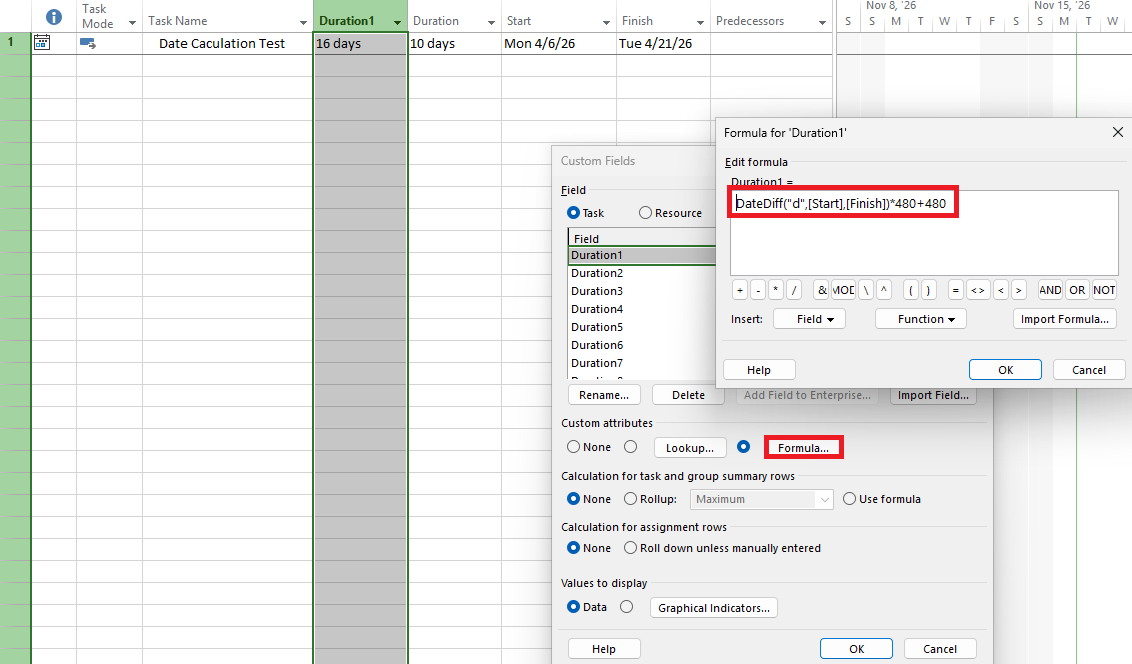
    If your goal is specifically to reproduce an Excel-style calendar-date calculation while still keeping Project's normal Duration available, another option is to create a custom Duration field and display it next to the standard Duration field.

    For example, under Project > Custom Fields, select a task field with Type = Duration, select Duration1, and use the following formula: DateDiff("d",[Start],[Finish])*480+480

    Here, 480 represents 8 hours × 60 minutes. This version counts the Start and Finish dates inclusively. For example, April 6 through April 21 would be represented as 16 calendar dates, while the normal Project Duration in my test was 10 working days.

    If your Excel calculation instead uses a straightforward Finish - Start calculation and does not count both boundary dates inclusively, use: DateDiff("d",[Start],[Finish])*480

    Using April 6 and April 21 as an example, this would correspond to 15 elapsed calendar days rather than 16 inclusive calendar dates.

    Therefore, there are three different calculations that can easily appear similar but produce different results:

    • Project Duration: scheduled working time based on the applicable calendar
    • Elapsed duration (ed): continuous elapsed duration
    • Custom calendar-day calculation: difference between the Start and Finish calendar dates
    Untitled

    Please feel free to reply below if you have any update or further concern. Thank you very much for your time and your cooperation.

    If you found my response helpful, please click "Yes" on the original answer and consider upvoting it using the account that posted this question.

    Was this answer helpful?


  2. AI answer

    2026-11-17T00:56:01.14+00:00

    Enter the task duration with the elapsed-day suffix, such as 7ed, when you want Project to count seven consecutive calendar days rather than seven working days.

    Use calendar-day durations

    1. In the Gantt Chart, locate the task’s Duration field.
    2. Enter the duration using ed instead of d:
      • 7d = seven working days according to the effective calendars.
      • 7ed = seven elapsed/calendar days, including weekends and other nonworking time.
    3. Press Enter and check the calculated Finish date.

    Project also supports elapsed hours, weeks, and months through eh, ew, and emo. Microsoft’s documented example states that 7d can run Monday through the following Tuesday when weekends are nonworking, whereas 7ed runs Monday through Sunday.^1^

    There is therefore still a calendar-days option, but it is expressed as an elapsed duration unit, not as a separate Duration setting.

    Why changing “hours per day” did not solve it

    Project’s normal Duration is the total span of active working time, not simple date subtraction.^2^ Changing Hours per day changes how Project converts a value expressed in days into hours; it does not turn d into calendar-day arithmetic. Those day/week conversion settings are global and independent of a particular calendar.^3^

    By contrast, Excel formulas such as FinishDate-StartDate count the difference between date serial values without applying Project’s working-time calendars. To compare like with like:

    • Excel calendar-date difference → use ed in Project.
    • Excel business-day calculation based on a work calendar → use ordinary d and make Project’s calendar match the Excel assumptions.

    If ordinary working-day durations are still inconsistent

    For tasks that should observe business hours rather than elapsed time, inspect the effective calendars instead of changing the hours-per-day conversion again:

    1. Select Project → Change Working Time.
    2. In For calendar, select the project calendar.
    3. Review Work Weeks → Details and the Exceptions tab for weekends, holidays, and working hours.
    4. Select Project → Project Information and verify that the intended project calendar is selected.
    5. For an affected task, right-click it and select Information → Advanced; check whether it has a task-specific calendar.

    Project can combine base, project, task, and resource calendars, and the resulting availability determines the scheduled dates.^4^ A task calendar can also override the project calendar.^5^

    Also enable a date format that displays the time, under File → Options → General → Date format. A hidden start or finish time can make two apparently identical dates represent different duration boundaries.^6^

    Use a 24 Hours project calendar only when the work itself must be scheduled continuously. For a task that merely needs a fixed calendar-time span while the rest of the project follows normal business calendars, ed is the more targeted choice.^7^


    References

    1. DurationFormat Element
    2. Duration Element
    3. Setting Hours per Week for a specific Calender - Microsoft Q&A
    4. Work with calendars in Project | Microsoft Support
    5. Create a calendar for a task within Project | Microsoft Support
    6. In MS Project the "Change Working Time" facility does strange things - Microsoft Q&A
    7. Set the general working days and times for a project | Microsoft Support
    AI-generated content may be incorrect. Read our transparency notes for more information.

    Was this answer helpful?

Your answer

Answers can be marked as 'Accepted' by the question author and 'Recommended' by moderators, which helps users know the answer solved the author's problem.