Developer technologies | VB
An object-oriented programming language developed by Microsoft that can be used in .NET.
This browser is no longer supported.
Upgrade to Microsoft Edge to take advantage of the latest features, security updates, and technical support.
' cx='32' cy='32' r='32' /%3E%3Ctext x='50%25' y='55%25' dominant-baseline='middle' text-anchor='middle' fill='%23FFF' %3EHU%3C/text%3E%3C/svg%3E)
I get "Login failed for User" error in visual basic connection to sql-server. This error occurs when I move my database from one PC to another.
I solve this problem by using same "PC-name" & "User-Name" of my old PC in new one.
How should I avoid this I mean I want to use different "PC-name" & "User-Name" on new system. Note that my Sql Login credentials are same in both New & Old PC still it won't let me login.
An object-oriented programming language developed by Microsoft that can be used in .NET.
Additional SQL Server features and topics not covered by specific categories

The error message is:
Cannot open database "POS" requested by the login. The login failed.
Login failed for user 'HSSS'.
There are two possible causes for this error:
I note that your connection string says Data Source =.. That is, you are logging on to the local instance. Obviously, just because a database exists on one machine, it does not mean that it exists on the other. So that is the first thing to check.
But I also note that you say when I move my database from one PC to another. And if that is what you have done, this can explain the problem. The mapping between login on server level and user on database level is not by name, but by SID. When you create an SQL Login on two different servers will typically have different SID - unless you take precautions.
That is, let's say you have created a login HSSS on server A, and now you want to move your database to server B. On server A, you run
SELECT suser_sid('HSSS')
When you create the login on server B, you say:
CREATE LOGIN HSSS WITH PASSWORD = '123456', SID = 0x...
where 0x... is the value you got in the first query.
In this case you have already created the login, so you need to drop it first.
@Erland Sommarskog Thank you very much this solved my problem; and it also cleared my different PC and User names issue also(Now I won't need to keep them same on any PC or new installations).
Once again a bundle of thanks.
@CathyJi-MSFT @Erland Sommarskog
Here are the details about the error.
My Connection String "Public Shared con As SqlConnection = New SqlConnection("Data Source = .; Initial Catalog = POS; User ID = XXXXX; Password = XXXXXX;")"
Error Details
https://drive.google.com/file/d/1cu5HnBNUMPy4Ip7pt5ZA-azcviG-8bqt/view?usp=sharing
Error Image
https://drive.google.com/file/d/1thZ1zjN-yVs0b4UxujLC8mWtwSvz6X6E/view?usp=sharing
'Was unable to upload file here directly due to error "No such upload." thus I used google drive.

Hi @Habib ur Rehman ,
> I mean I want to use different "PC-name" & "User-Name" on new system. Note that my Sql Login credentials are same in both New & Old PC still it won't let me login.
Agree with Erland. In addition, please make sure that the user account used in connection string is created in SQL server logins under security folder in new PC .
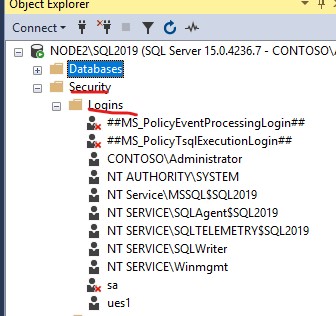
Please share us more detail error message for analysis.
If the answer is helpful, please click "Accept Answer" and kindly upvote it. If you have extra questions about this answer, please click "Comment".
How should I avoid this I mean I want to use different "PC-name" & "User-Name" on new system. Note that my Sql Login credentials are same in both New & Old PC still it won't let me login.
I'm not sure that I get this. First you say that you want to use different user-names, and then you say that your SQL login credentials are the same in both?
Are you using Windows authentication or SQL authentication? What does your connection string look like?
If you look in the SQL Server errorlog, you will find more details on why connection failed.